
Submit Inquiry
27 West Beaver Creek Road Unit #2
Richmond Hill, ON, CANADA L4B 1M8

International:

1-905-886-0335

US & Canada:

1-800-265-5696

Best Exercise Bench Manufacturers in China for Global Buyers

Choosing the best Exercise Bench manufacturers in China requires more than comparing factory prices. Global buyers need evidence of engineering quality, production consistency, and export experience. The market is expanding.

The Global Wellness Institute valued the global physical activity economy at approximately US$1.1 trillion in 2022. Its report also identifies fitness facilities and home exercise as major growth areas. Meanwhile, ACSM’s Worldwide Survey of Fitness Trends repeatedly places strength training among mainstream fitness priorities. These figures support continued demand for adjustable benches, Olympic benches, and compact home-gym models.

Yet market growth does not guarantee reliable suppliers. A polished website can hide weak welding, unstable adjustment mechanisms, or inconsistent foam density. I have seen small details matter: a loose backrest pin, sharp frame edges, or packaging that fails during sea freight. Buyers should examine factory audits, material certificates, load-test records, and after-sales procedures. ISO 20957 and relevant EN safety requirements provide useful reference points, although compliance claims still require verification.

Price alone is a poor filter.

This guide evaluates leading Chinese manufacturers through practical criteria, including manufacturing capacity, product design, quality control, customization, certifications, and international shipping support. Public market reports offer useful direction, but their figures may differ by category and research method. That limitation deserves attention. A suitable supplier must match the buyer’s actual needs, from a 150-kilogram home bench to a commercial model built for repeated daily use. The strongest partnerships usually begin with samples, clear specifications, and honest testing—not promises written in oversized fonts.
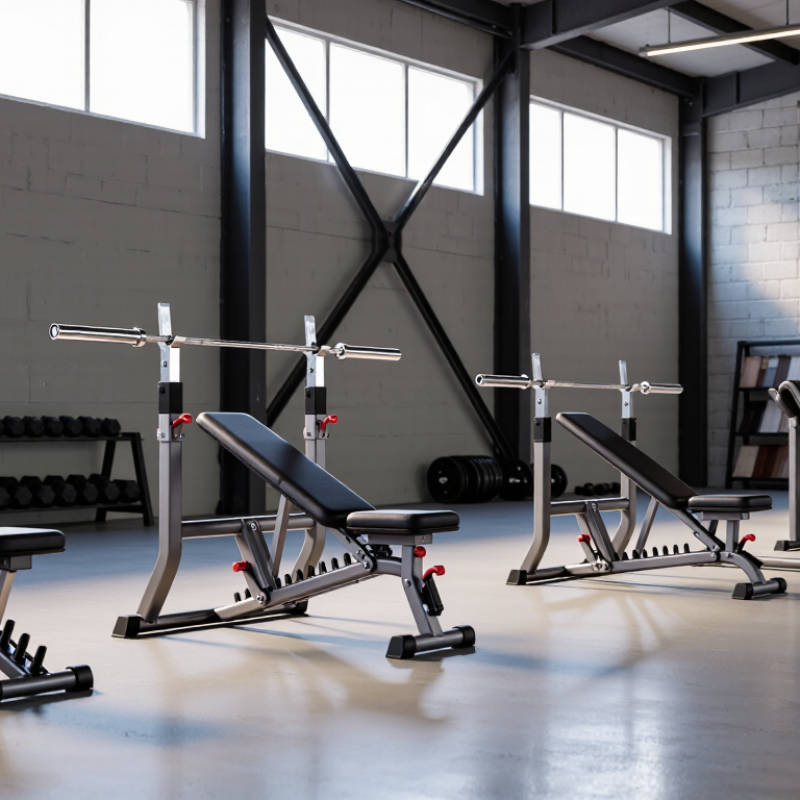
Best Exercise Bench Manufacturers in China for Global Buyers

Define Exercise Bench Types Under ISO 20957-1 and ASTM F2276 Standards

Best Exercise Bench Manufacturers in China for Global Buyers

Under ISO 20957-1 and ASTM F2276, an exercise bench should be evaluated by function, stability, loading, and user environment. These standards do not simply create marketing labels such as “premium” or “commercial.” They require manufacturers to consider foreseeable use, structural safety, moving parts, instructions, and warning information. Buyers should request test records, rated load data, and product drawings before approving samples.

A flat bench provides a fixed horizontal platform for pressing and supported exercises. An adjustable bench adds backrest positions, such as incline, flat, or decline. A rack-integrated bench works with uprights or bar supports and needs careful assessment of bench stability and clearance. Folding benches save storage space, but their locking mechanisms require repeated-use checks. These categories help global buyers compare products, but they are not always official standard classifications.

In factory audits, small details often reveal more than polished brochures. Inspect welds near hinge points, pinch-point protection, pad attachment, and rubber foot contact. ASTM F2276 can support performance and safety evaluation, while ISO 20957-1 provides a broader framework for stationary training equipment. Compliance claims should match the tested configuration, intended users, and installation instructions. A heavier frame is not automatically safer. That assumption needs testing. Some suppliers also describe a bench as “adjustable” when its range is limited or difficult to verify. Ask for cycle testing and independent inspection evidence. No classification is perfect.

Best Exercise Bench Manufacturers in China for Global Buyers

Exercise Bench Types Under ISO 20957-1 and ASTM F2276 Standards

The chart compares commonly specified backrest adjustment ranges for major exercise bench types. Values are representative procurement benchmarks rather than mandatory limits. ISO 20957-1 and ASTM F2276 focus on safety, stability, performance, warnings, and user protection; they do not prescribe one universal adjustment angle for every bench type.

Screen Chinese Manufacturers Using 2023 Sports-Equipment Export Data

Choosing the best exercise bench manufacturers in China requires more than comparing catalog prices. I use 2023 sports-equipment export data as an initial screening tool. Shipment frequency can reveal production stability. Destination diversity may indicate experience with different buyer requirements. However, export records can group benches with other fitness products, so HS-code details need careful checking.

A stronger review combines trade data with factory evidence. I check whether the manufacturer shipped consistently throughout 2023, rather than showing one unusually large order. I also request recent product photos, packing records, and inspection documents. During a factory visit, I examine welds, adjustment pins, upholstery stitching, and frame alignment. A practical load test matters more than polished product images. Ask for test methods and recorded results.

Export data has limits. It does not prove material quality, after-sales support, or ethical production. I have seen factories with impressive shipment volumes but weak quality controls. That is an uncomfortable finding. Buyers should compare declared steel thickness, maximum user weight, carton protection, and replacement-part policies. Check the details. Speak with recent customers when possible. A reliable supplier should answer clearly, provide consistent documentation, and accept reasonable pre-shipment inspection. Still, no screening method is perfect. Trade statistics change, product classifications remain imperfect, and one audit cannot represent every production batch.

Verify OEM Capacity, ISO 9001 Systems, and EN 20957 Compliance Records

Best Exercise Bench Manufacturers in China for Global Buyers

A reliable supplier must prove more than a polished catalog. China’s exercise bench market is competitive, but OEM capacity varies sharply between factories. Request production photos, equipment lists, monthly output, and recent export records. Check whether welding, foam cutting, powder coating, and final assembly happen in-house. A sample bench should match mass production, including weld penetration, pad alignment, bolt torque, and frame thickness.

ISO 9001 matters when records support it. The ISO Survey of Certifications 2023 reported more than 1.26 million ISO 9001 certificates worldwide. Certification alone is not enough. Ask for the certificate scope, issuing body, audit date, corrective-action records, and document-control process. Review incoming steel inspections and final load-test reports. Small gaps often appear there. They should not.

For EN 20957 compliance, verify the exact standard parts and test scope for the bench design. Request laboratory reports, risk assessments, test photos, and traceable sample numbers. Check stability under load, adjustment locking, pinch points, sharp edges, padding durability, and warning labels. An internal factory test can support development, but an independent laboratory report provides stronger evidence. Some suppliers may offer incomplete documents or outdated versions. That is a practical warning sign. A careful buyer should compare the tested model with the shipped model, because design changes can quietly invalidate earlier results.

Best Exercise Bench Manufacturers in China for Global Buyers - Verify OEM Capacity, ISO 9001 Systems, and EN 20957 Compliance Records
Evaluation Dimension Recommended Verification Benchmark Evidence a Qualified Supplier Should Provide Buyer Verification Method Assessment Status Commercial Relevance
OEM Product Development Ability to convert buyer drawings, specifications, packaging requirements, and target-cost objectives into controlled production documents. Product drawings, bill of materials, revision history, sample approval records, and documented engineering change procedures. Compare the approved prototype with the production drawing and inspect revision control during a factory audit. Required Reduces specification deviations and supports private-label launches for different markets.
Frame and Welded Structure Consistent steel grades, tube dimensions, weld quality, load-bearing design, and corrosion protection suitable for the intended use class. Material certificates, incoming inspection records, weld inspection criteria, coating specifications, and structural test reports. Check material certificates against actual incoming stock and inspect welds, joints, pivot points, and coating thickness. Verify by Audit Directly affects stability, service life, safety, and warranty exposure.
Adjustment and Locking System Positive locking of backrest, seat, leg-support, and incline positions without unintended release during normal use. Adjustment mechanism drawings, cycle-test records, locking-force specifications, and failure-mode analysis. Operate every adjustment position on production samples and review repeated-cycle test results. Required Important for user safety, product usability, and claims prevention.
EN ISO 20957-1 Alignment Product design and testing aligned with the applicable requirements of EN ISO 20957-1 for stationary training equipment. Applicable test plan, risk assessment, test reports, technical construction file, and declaration or conformity documentation where applicable. Confirm that the report identifies the exact model, configuration, test methods, test laboratory, and applicable standard edition. Required Provides a recognized technical framework for safety evaluation of stationary training equipment.
Product-Specific EN 20957 Scope Additional parts of the EN 20957 series should be considered when the bench is integrated into a broader strength-training system or supplied with accessories. Scope statement explaining which standard parts were assessed and why each part is applicable or not applicable. Match the intended product function, accessories, and user class with the laboratory’s scope statement. Verify by Audit Prevents the use of a general test report that does not cover the actual product configuration.
ISO 9001 Quality System Current ISO 9001:2015 certification covering the manufacturing site and relevant activities. Certificate showing legal entity, site address, scope, certificate number, issue date, expiry date, and certification body. Verify the certificate through the certification body or an accredited certification database; ensure the audited site matches the shipping site. Required Indicates a formal quality-management system, but it does not replace product testing or factory inspection.
Incoming Material Control Documented inspection of steel, upholstery materials, foam, fasteners, plastic parts, and purchased components before use. Supplier approval list, incoming inspection plans, sampling records, nonconformance reports, and corrective-action records. Trace randomly selected production materials back to purchase orders and inspection records. Required Controls dimensional variation, material substitution, and inconsistent component quality.
Process and Final Inspection Defined inspection points for welding, assembly, upholstery, adjustment operation, stability, labeling, and packaging. Inspection checklists, acceptance criteria, calibrated measuring-equipment records, batch-release records, and defect-rate data. Conduct a pre-shipment inspection using an agreed sampling plan and compare results with the supplier’s records. Required Improves shipment consistency and provides objective release criteria.
Traceability Finished goods should be traceable to production date, batch, work order, and critical component suppliers. Lot coding procedure, production records, carton labels, inspection reports, and retention-period policy. Select cartons from different pallets and confirm that records can identify the production batch. Preferred Supports recalls, root-cause investigations, and after-sales service.
Load and Durability Testing Testing should reflect the declared user weight, loading configuration, adjustment positions, and intended usage class. Test fixtures, applied loads, cycle counts, acceptance criteria, test dates, and model-specific results. Review raw data and observe a repeat test on an unmodified production sample where commercially practical. Required Helps validate structural integrity beyond a visual inspection or one-time static load check.
Upholstery and Comfort Materials Consistent foam density, cover material, seam strength, edge finishing, and resistance to expected cleaning conditions. Material specifications, supplier declarations, seam or peel-test records, color references, and sample approval documentation. Compare production upholstery with the approved golden sample and inspect seams, staples, edges, and odor. Verify by Audit Influences perceived quality, user comfort, return rates, and replacement-part demand.
Packaging and Export Readiness Packaging should protect frames, upholstery, adjustment parts, and hardware during international transport and warehouse handling. Packaging drawings, carton specifications, drop-test or transport-test records, pallet plan, and packing instructions. Inspect a packed sample, review carton dimensions and gross weight, and conduct a packaging drop or compression review when needed. Required Reduces transit damage, dimensional-weight costs, and customs or warehouse handling problems.
Spare Parts and After-Sales Support Availability of adjustment pins, upholstery parts, hardware, wheels, end caps, cables, and other service components for the agreed support period. Spare-parts list, exploded diagrams, service instructions, response-time commitment, and warranty policy. Order a small selection of spare parts and verify identification, lead time, packaging, and compatibility. Preferred Supports distributors and reduces downtime for commercial and home users.
Factory Capacity and Delivery Control Capacity should be evaluated against the buyer’s forecast, required production window, peak-season plan, and quality-control staffing. Production-line layout, equipment list, monthly planning records, capacity calculation, subcontractor list, and recent on-time delivery data. Audit the manufacturing site, compare stated capacity with work-in-progress, and request shipment records with customer details removed. Verify by Audit Separates genuine manufacturing capability from trading or heavily outsourced supply models.
Compliance Record Authenticity All certificates and reports should be current, model-specific, traceable, and issued by identifiable organizations. Original PDF files, issuing-body details, laboratory accreditation information where applicable, test dates, model numbers, and authorized signatures. Contact the issuing organization independently and check that the tested configuration matches the purchase specification. Required Protects global buyers from expired, altered, recycled, or non-product-specific documentation.

Note: ISO 9001 certification demonstrates a quality-management system and does not by itself prove compliance with EN ISO 20957 or guarantee product performance. Buyers should verify current certificates, applicable standard scope, model identity, factory address, and test evidence before placing an order.

Compare MOQ, Lead Time, Warranty Terms, and Tested Load Ratings

Best Exercise Bench Manufacturers in China for Global Buyers

For global buyers, MOQ is often the first commercial filter. Chinese exercise bench manufacturers may quote 20 to 100 units for standard models, while custom upholstery or frame colors can require 200 units or more. Lead times commonly range from 25 to 45 days after deposit and artwork approval. A 2024 Grand View Research assessment valued the global home fitness equipment market at over USD 11 billion, showing why production capacity matters. Still, a low MOQ can hide higher unit costs.

Ask for a written warranty matrix. A credible supplier should separate frame coverage, upholstery coverage, and moving-part coverage. Five years for the steel frame and one year for pads or hardware is a practical benchmark, but terms vary. Confirm whether shipping, labor, and replacement parts are included. Read the exclusions carefully.

Tested load ratings need more scrutiny. A bench marked “600 kg capacity” may describe a static laboratory load, not safe training weight. Request the test method, duration, failure photos, and laboratory credentials. ASTM exercise-equipment guidance and ISO/IEC 17025 testing practices offer useful reference points. A 2024 industry survey from ACSM also highlights growing demand for strength equipment, but demand does not prove durability. I would record serial samples, weld photographs, and repeated incline adjustments before approval. One sample can pass. Ten may not.

Calculate Landed Cost with HS 9506.91 Duties, Freight, and After-Sales Data

For global buyers, the factory price is only the starting point. Under HS 9506.91, confirm the destination country’s tariff line before ordering. Classification can change with bench functions, attachments, and materials. The International Trade Centre Trade Map and official customs tariff databases provide useful verification. Do not rely on a supplier quotation alone.

A practical landed-cost model is: product cost, export packing, inland delivery, freight, insurance, duty, import VAT, brokerage, and local delivery. For example, a bench costing $85 may add $15 for reinforced packing, $22 for ocean freight, and $8 for brokerage.

If the customs value is $122 and a 4.6% duty applies in an illustrative U.S. case, duty equals $5.61. VAT or sales tax may then apply to a broader taxable base. Rates differ by country.

Freight still moves unpredictably. Drewry’s World Container Index shows how sharply ocean prices can change between booking weeks, although LCL shipments follow different pricing. The World Bank Logistics Performance Index 2023 also highlights uneven clearance and delivery performance across markets. China ranked 19th, with a 3.7 score.

That sounds strong, but port congestion can still delay one pallet. Ask for carton dimensions, gross weight, HS documentation, spare-part terms, and response times. I would budget a 5–10% contingency. It feels conservative, yet small accessorial charges are easy to miss.

123